
Shinobu Homma was born in Niigata, Japan. He spent his adolescence years at his grandparents' house in Sado Island. The house had a long history and was built in the Japanese traditional post and beam system. He developed the appreciation of and the sense for the materiality and texture that were an essential part of architectural detailing during this period. In his last year of high school, Shinobu read in the Asahi newspaper an essay by Uzo Nishiyama, a Japanese modernist architect and urban theorist, and was inspired to pursue a career in architecture. He completed a Bachelor of Technology in Architecture at Tokyo University of Science (Tokyo Rika University).
Shinobu met his future wife, Lucy, who was a sansei Japanese Canadian teaching English in Japan, while working at an architectural firm in Tokyo. Lucy decided to return to Canada in the fall of 1979 and invited Shinobu to tag along to visit the country. They arrived in Vancouver after travelling in Southeast Asia, India and Europe extensively for 3 months. Soon after arriving in Vancouver, Lucy lost her father in a boating accident while he was fishing, and Shinobu decided to stay in Canada to support the Komori family.
Shinobu struggled initially in Canada, being unable to work while waiting for his immigration status and with limited English abilities. He also faced racial prejudice while living in Vancouver and Toronto, which deeply affected him.
Shinobu worked for Bing Thom Architects for more than 30 years. The firm later became Revery Architecture after Bing Thom passed away suddenly in Hong Kong in the fall of 2016. Shinobu was the Technical Principal from 2017 until 2025 when he retired. His finesse and design sensitivity was apparent in numerous projects such as the Chan Centre for Performing Arts, Surrey Central City SFU, Surrey City Central Library, Aberdeen Center Complex and The Butterfly—a complex and intricate residential tower with an integrated heritage church in downtown Vancouver. He contributed to bringing many architectural concepts to life across Canada, USA, and Hong Kong. “Architecture should be like ballet,” Shinobu noted, “where you cannot see the sweat and other signs of effort–only beauty and simplicity.”
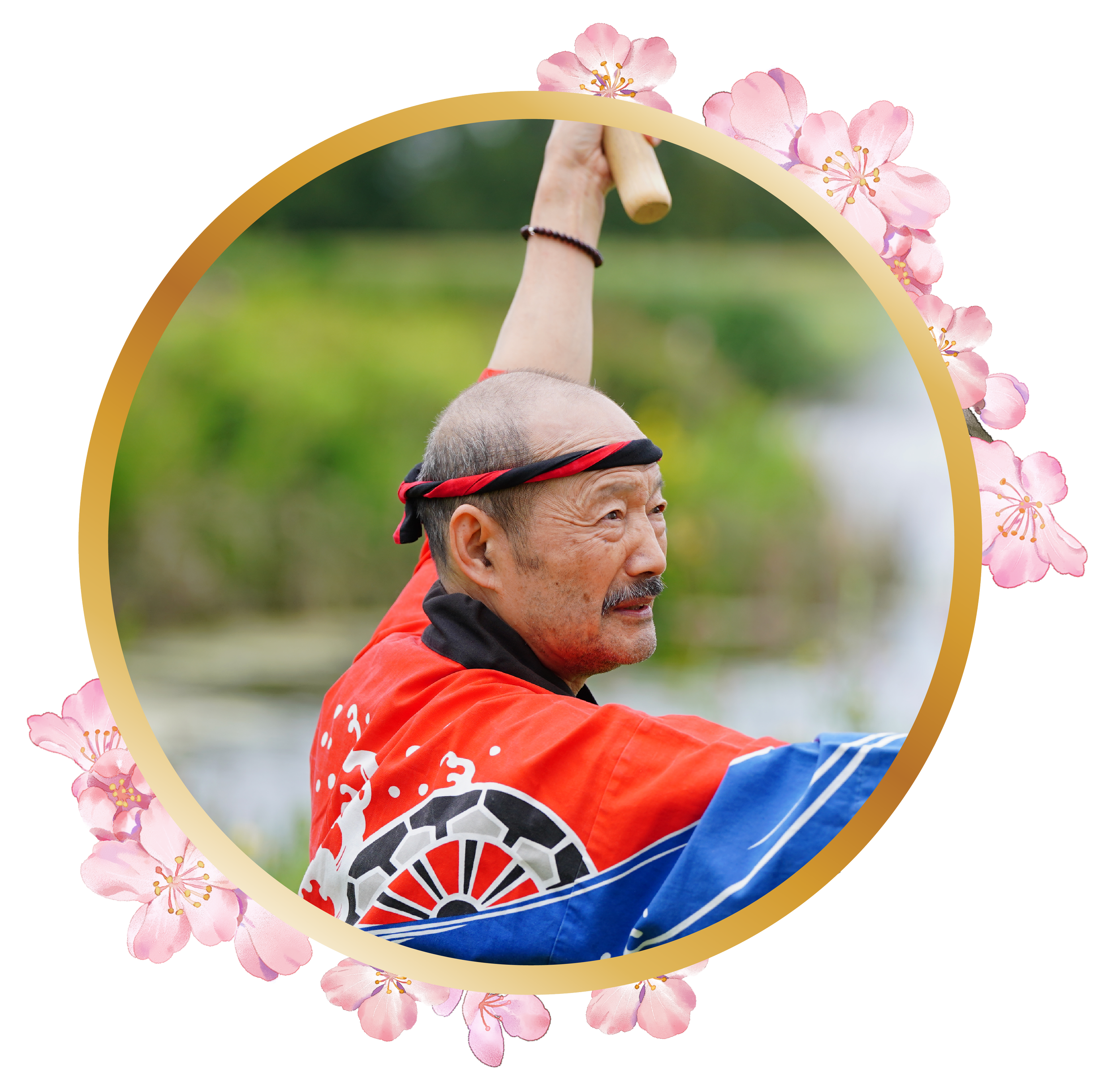
Outside of his profession, Shinobu is passionately involved in taiko drumming. He was struck by the sound of taiko during matsuri (Japanese festivals) in his childhood.
While working for a house builder in Vancouver in 1980, he met Rick Shiomi, a sansei Japanese Canadian trying to start Canada’s first taiko group with a dozen like-minded friends. On the second floor of the Fujiya Fish Store on Powell Street, where the group practiced, Shinobu began his taiko journey and joined as a founding member of Katari Taiko.
Shinobu would go on to found Wasabi Daiko when he moved to Toronto in 1985, and Chibi Taiko in 1993 after returning to Vancouver. In Chibi Taiko, he focused specifically on training children and youth, including his daughter Kayo who joined the group, making it the first children’s taiko group in Canada.
Shinobu believes taiko can teach valuable life lessons to youth, such as cooperation, leadership, responsibility and spirituality. He hopes for the next generations to continue deepening their connection and appreciation for their cultural heritage, get involved in community activities, and develop a lifelong discipline. Continuing in his passion and dedication to taiko, Shinobu has aspirations to connect Japanese Canadian communities all across Canada through taiko. He hopes to build a taiko, music and dance center in his lifetime to advocate and spread this unique performing art form to the wider population.